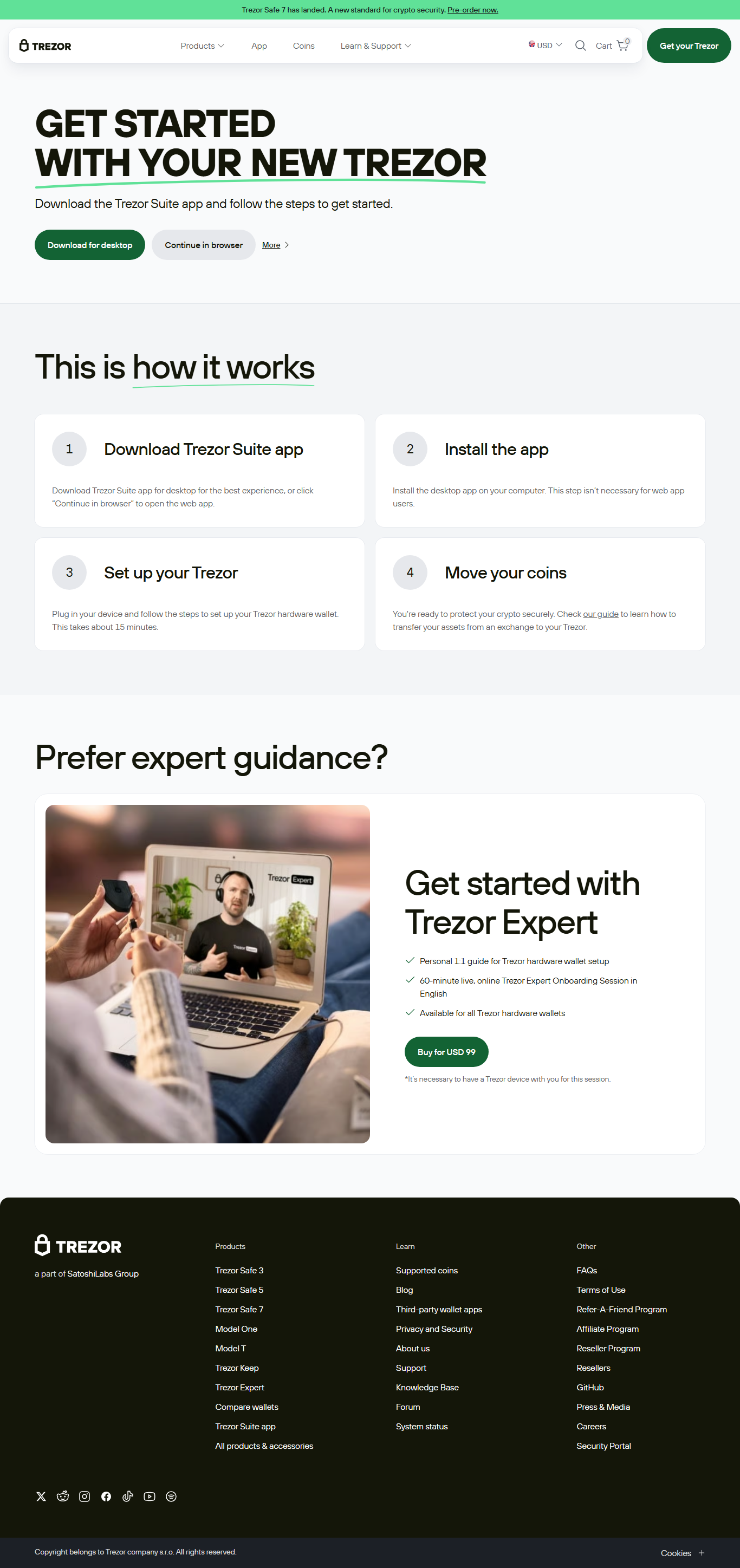
Trezor.io/Start: Breaking the Myths & Securing Your Crypto in 2025
Your complete deep-dive into the security realities of trezor.io/Start — uncovering how to safeguard your wallet, debunk common misconceptions, and apply practical protection strategies for the crypto future.
1. Understanding Trezor.io/Start’s Real Purpose
Trezor.io/Start isn’t just a setup page — it’s the central, secure onboarding gateway that ensures users connect only through legitimate Trezor firmware and software. It serves as the authentication bridge between your physical wallet and Trezor Suite, confirming digital integrity before any crypto data transfers begin.
Behind the scenes, this portal uses TLS encryption, cryptographic device handshake, and signature verification to prevent tampering. Simply put, it ensures your hardware wallet communicates with nothing but Trezor’s official infrastructure.
2. Common Security Myths About Trezor.io/Start
There’s a lot of misinformation floating around crypto communities. Let’s set the record straight with facts backed by 2025’s security standards:
- Myth #1: “If I connect to Trezor.io/Start, my seed is at risk.”
Truth: The website never asks for or reads your recovery seed. That information remains within the Trezor hardware, offline and encrypted. - Myth #2: “Firmware updates can be manipulated.”
Truth: Every firmware file downloaded through the portal is cryptographically signed. Trezor devices refuse unsigned or modified firmware. - Myth #3: “Hackers can clone the Start page.”
Truth: While phishing clones exist, the authentic https://trezor.io/Start uses HSTS, verified SSL, and DNSSEC to stop spoofing attempts.
3. Security Architecture Behind Trezor.io/Start
The portal integrates multiple protective systems working together:
a. Cryptographic Verification
Ensures all firmware updates and Suite installations originate from verified Trezor signatures using SHA-256 integrity checks.
b. Secure Handshake
Device and Suite establish mutual authentication, verifying both sides before enabling communication or data transfers.
c. Local Data Encryption
All user preferences, coin settings, and device info are stored encrypted locally, never uploaded to the cloud.
4. Real-World Threats Every User Should Know
Even with robust systems like trezor.io/Start, users remain the last line of defense. Awareness is critical:
- Phishing Clones: Fake sites mimic the original URL. Always verify “trezor.io” with SSL certificate validation.
- Firmware Tampering: Counterfeit devices may ship with rogue firmware. Only use official Trezor packaging and verify authenticity through Suite.
- Public USB Ports: Charging or connecting your wallet in public hubs can expose it to data skimming.
- Social Engineering: No Trezor employee or support agent will ever ask for your recovery words — period.
5. 2025’s New Safety Features on Trezor.io/Start
Trezor’s developers continuously upgrade the user security stack. The latest update introduced several proactive layers of protection:
- Dynamic Domain Verification: Suite automatically validates that you’re connected to the authentic trezor.io/Start server.
- Enhanced USB Whitelisting: Prevents device communication from non-Trezor apps or emulators.
- Real-Time Threat Alerts: Integrated warning banners detect cloned websites or suspicious browser behavior.
- Hardware Self-Test Mode: Your Trezor now runs an internal integrity check before every transaction.
6. User-Controlled Privacy Through Trezor Suite
Using Trezor.io/Start automatically routes you to download Trezor Suite — the control center for your wallet. The Suite’s privacy tools empower users with:
- Tor integration for full IP obfuscation.
- CoinJoin compatibility for private Bitcoin transactions.
- Optional “discreet mode” hiding balances from your screen.
These features transform Trezor from a wallet into a complete sovereignty tool — no tracking, no centralized control.
7. How to Recognize a Fake Trezor.io/Start Site
Hackers frequently replicate Trezor.io/Start to trick users. Follow these simple checks to spot counterfeits instantly:
- ✅ URL Accuracy: The official link is https://trezor.io/Start (capitalization ignored).
- ✅ Certificate Check: Click the padlock icon → it must show “Trezor Company s.r.o.”
- ✅ No Seed Requests: The page never asks for recovery words.
- ✅ Suite Download Link: Redirects only to suite.trezor.io, not third-party hosts.
8. Practical Steps for Maximum Protection
Combining Trezor’s inbuilt protection with good user hygiene multiplies your safety exponentially. Here’s a 2025 checklist:
- Buy only from the official Trezor store or verified resellers.
- Keep your recovery seed in two offline, fireproof locations.
- Regularly check for firmware updates through Suite.
- Use Tor or VPN when managing funds.
- Enable “hidden wallet” mode for additional passphrase security.
9. Security Evolution: What’s Coming Next?
The Trezor team has teased upcoming features that will redefine wallet security:
- 🎯 Quantum-Resistant Firmware: Ready for post-quantum encryption compatibility.
- 🔐 Fingerprint Verification: Experimental biometric layer for wallet unlocks.
- 🌐 Web3 Native ID: Secure decentralized identity authentication through your Trezor.
These innovations reflect the company’s proactive approach to staying ahead of both hackers and emerging tech paradigms.
10. FAQs: Trezor.io/Start Security Questions
Q1. Can malware modify my Trezor firmware?
No. The device won’t run unsigned firmware. You’ll see a red warning if any tampering is detected.
Q2. Is it safe to connect through Wi-Fi?
Yes, but always use private, password-protected connections. Avoid public hotspots or shared networks.
Q3. What if my Trezor is stolen?
Without your PIN and recovery seed, the thief cannot access your crypto. Reset your wallet and restore from backup immediately.
Q4. Do I need antivirus protection?
Yes — while Trezor is hardware-isolated, keeping your computer malware-free prevents fake update popups or redirects.